The futures canon has a diversity problem.
Walk into most bookstores and you’ll find business books promising to decode what’s coming, usually written by consultants, tech executives, and academics who share remarkably similar demographics and worldviews. Their frameworks center technology, markets, and innovation as the primary drivers of change.
Who gets to imagine the future shapes what futures become possible. When one demographic dominates foresight literature, we inherit their blind spots, their assumptions, their unexamined beliefs about how change works and who it serves.
The books below expand what futures thinking can be. Written by women and people of color, they ask different questions, notice different patterns, and imagine possibilities that rarely make it into mainstream future-of-work bestsellers. They treat futures work as a practice of meaning-making, where whose voices shape the conversation determines whose futures get built.
“There’s no single answer that will solve all our future problems. There’s no magic bullet. Instead there are thousands of answers—at least. You can be one of them if you choose to be.”
— Octavia E. Butler
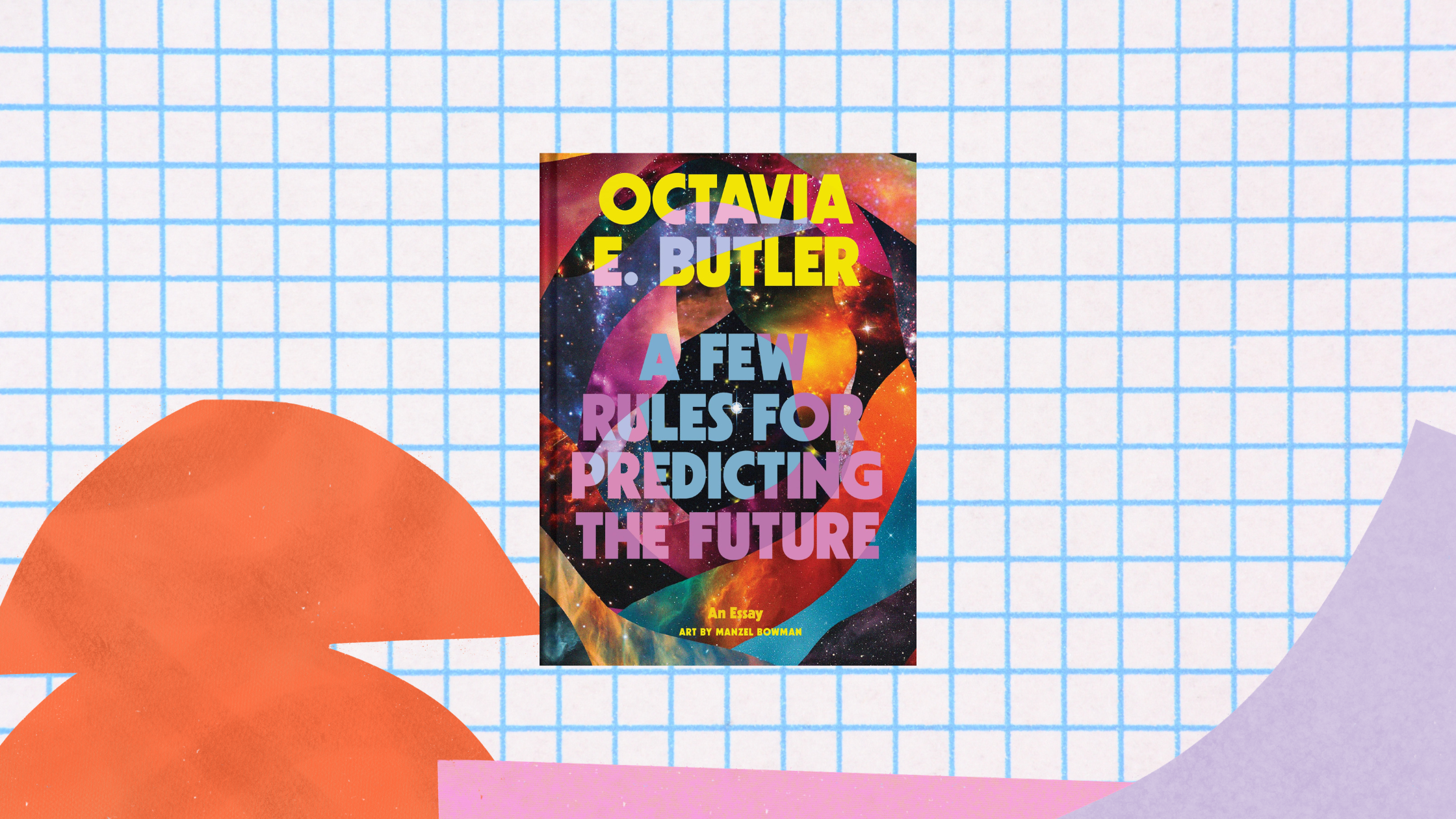
A Few Rules for Predicting the Future by Octavia E. Butler
Octavia Butler didn’t predict the future through trend analysis or technological forecasting. She watched people. She studied power. She paid attention to what systems do under pressure.
This slim essay, gorgeously illustrated by Manzel Bowman, distills Butler’s approach to futures thinking into a handful of principles that feel more relevant now than when she first articulated them. She writes about pattern recognition, about understanding that humans are both hierarchical and adaptable, about seeing change as the only constant we can depend on.
Butler’s “rules” work through observation rather than prescription. She noticed that when resources become scarce, people reliably choose certain survival strategies. She saw how power concentrates, how communities fracture, how new social arrangements emerge from crisis. Then she wrote those patterns forward.
Reading this essay offers a master class in futures thinking from someone who saw it all coming: Climate refugees, corporate-controlled governance, religious extremism rising from economic desperation. She didn’t need big data or AI models. She paid attention to what people do when the world stops working.
For anyone doing futures work, this book clarifies the difference between prediction and prophecy. Prediction extrapolates trends. Prophecy understands human nature under pressure.
Imagination: A Manifesto by Ruha Benjamin
Ruha Benjamin’s Imagination: A Manifesto is a field guide for treating imagination as critical infrastructure for social change. The Princeton professor argues that racism, sexism, and classism all emerged from human imagination — making imagination the essential tool for dismantling them. She highlights educators, artists, and activists who are crafting new stories that reflect our interconnection and offering creative approaches to seemingly intractable problems. Taking Toni Morrison’s instruction to heart — “Dream a little before you think” — Benjamin insists that our collective imaginations already contain everything we need to build the world we want to live in.
Positive Obsession: The Life and Times of Octavia E. Butler by Susana M. Morris
Understanding Butler’s futures requires understanding her life. Susana M. Morris’s Positive Obsession is a cultural biography that situates Octavia Butler’s life and work within the movements that shaped her: Civil Rights, Black Power, women’s liberation, queer rights, and Reaganomics.
Drawing on correspondence, interviews, unpublished manuscripts, and Butler’s extensive personal journals, Morris reveals the human being behind the genius — a shy, dyslexic only child who persisted through doubt and isolation to become the first Black woman to consistently publish science fiction.
The title comes from Butler’s own term for her drive to write: “Positive obsession is about not being able to stop just because you’re afraid and full of doubts. Positive obsession is dangerous. It’s about not being able to stop at all.” Morris traces how Butler’s cautionary tales about fascism, climate chaos, and gender-based violence emerged from a life spent imagining futures with Black women at the center.
Outgrowing Modernity by Vanessa Machado de Oliveira
Vanessa Machado de Oliveira writes from the premise that modernity itself needs examination. The entire framework — linear time, extractive economics, the human/nature binary, the myth of endless growth — might need composting rather than reform.
This book refuses easy answers. It asks readers to sit with discomfort, to acknowledge complicity, to recognize that we are all entangled in systems that harm us even as we benefit from them. Machado de Oliveira writes about decolonizing imagination itself. About learning to think in cycles rather than timelines. About metabolizing harm instead of denying it.
She draws on Indigenous epistemologies, particularly from Brazilian traditions, to articulate what she calls “hospicing modernity” — the practice of accompanying a dying system with honesty and care while midwifing what wants to emerge.
Dismantling the Master’s Clock: On Race, Space, and Time by Rasheedah Phillips
Rasheedah Phillips is a lawyer, a DJ, a speculative fiction writer, and one of the most interesting thinkers working at the intersection of time, Blackness, and futurity. This book emerges from her work with the Afrofuturist Affair and Black Quantum Futurism, projects that treat time as contested terrain.
Phillips argues that the way we’re taught to experience time — linear, progressive, moving from past to future in a straight line — serves particular systems. Capitalism requires us to believe that time is money, that efficiency is virtue, that the future is a destination we’re racing toward.
She explores alternative temporalities like circularity, simultaneity, temporal autonomy. She writes about how marginalized communities have always practiced non-linear time as a survival mechanism, how memory and futurity collapse into each other in Black cultural production, how we might build temporal justice movements.
Why This Matters
These five books share an understanding that futures work is never neutral. Every forecast embeds assumptions about whose lives matter, whose knowledge counts, whose visions deserve resources.
When white men dominate futures literature, we get futures that center their concerns: technological advancement, market disruption, efficiency, scale. We get Mars colonies before universal healthcare. We get “move fast and break things” instead of “move carefully and repair what’s broken.”
The writers above offer different starting points. What if we centered care instead of innovation? What if we valued cyclical time instead of linear progress? What if we treated imagination as a commons instead of intellectual property? What if the future was about learning to live here with humility and attention?
The crises we face — climate collapse, mass incarceration, algorithmic oppression, the unraveling of democratic institutions — emerged from imaginations that couldn’t see beyond extraction, accumulation, and control.
We need different imaginations. Different questions. Different people leading the conversations about what comes next.
These books are a start!


